Note
Go to the end to download the full example code.
Optical pumping in 171YbOH#
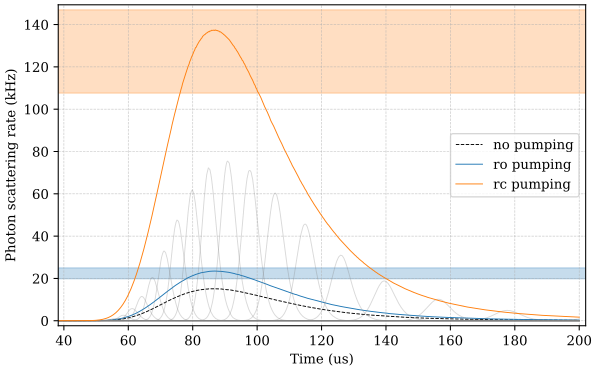
Beyond diatomic molecules, recent years have seen major advances in the direct laser cooling and control of polyatomic species. A particularly relevant case is ytterbium monohydroxide (YbOH), whose odd isotopologues \(^{173}\text{YbOH}\) and \(^{171}\text{YbOH}\) are of great interest as sensitive probes for nuclear properties and tests of fundamental symmetries. Motivated by these applications, optical cycling in these isotopologues has recently been demonstrated for the first time.
In this tutorial, we will model the optical cycling process in 171YbOH to highlight the key mechanisms that enable photon scattering in such polyatomic systems.
Import and function definition#
from MoleCool import System, np, plt, save_object, open_object
from MoleCool.spectra import multiindex_filter as filt
from MoleCool.tools import gaussian
import os.path

def fun(system):
    t_cut  = (system.lasers[-1].r_k[0]-3e-3)/system.v0[0]
    Nscatt = np.where(system.t>t_cut, system.Nscattrate[0], 0)
    Nscatt = np.interp(system.t_plt, system.t, Nscatt, right=0, left=0)
    return {'Nscatt':Nscatt}
Level system initialization#
if __name__ == '__main__':
    if not os.path.isfile("YbOH.pkl"):
        system = System(load_constants='171YbOH')

        system.levels.add_electronicstate('X','gs')
        system.levels.add_electronicstate('A','exs')

        system.levels.X.load_states(v=[0,1])
        system.levels.A.load_states(v=[0])

        system.levels.X.add_lossstate()
Since we added a loss state which includes a vibrational state with the
vibrational quantum number which is by 1 greater than the maximum v.
So, we deliberately must add another vibrational level in the pandas.DataFrame
system.levels.vibrbranch and system.levels.wavelengths for the loading
to be working.
        system.levels.vibrbranch.loc[('X',2),:]  = 1 - system.levels.vibrbranch.sum()
        system.levels.wavelengths.loc[('X',2),:] = 700

        # system.levels.print_properties()
Transition spectrum#
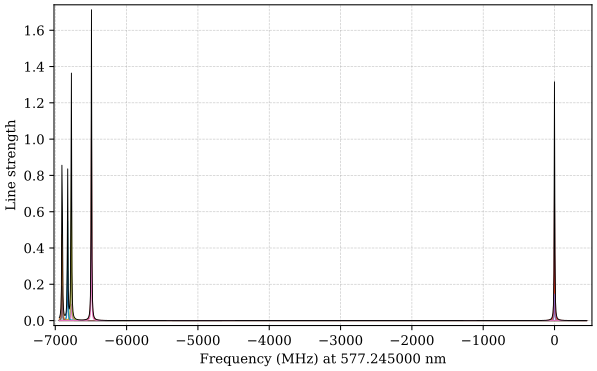
Let’s have a look how the transition spectrum looks like:
        system.levels.plot_transition_spectrum(
            wavelengths = [float(system.levels.wavelengths.loc[('X',0)])*1e-9],
            subplot_sep = 2000,
            N_points    = 1000,
            relative_to_wavelengths = True,
            # QuNrs       = [['G','F'],['F']], # formatting for legend
            legend      = False,
            )
Initial population and velocity#
        system.levels.X.set_init_pops({'v=0':1/1.11,'v=1':0.11/1.11})
        # system.levels.X.set_init_pops({'v=0,G=1,F1=1':1/1.11*6/24,
        #                                 'v=1,G=1,F1=1':0.11/1.11*6/24})

        system.set_v0(
            # v0 = [170,0,0],
            v0 = np.linspace(80,400,100),
            direction = 'x',
            )

        system.t_plt = np.linspace(0,0.2e-3,800)
Calculation routine#
        colors  = dict(ro='C0', rc='C1', nopump='k')
        D_exp   = dict(ro=0.48+0.17*np.array([+1,-1]), rc=7.4+1.3*np.array([+1,-1]))
        labels  = dict(rc='rc pumping',ro='ro pumping',nopump='no pumping')
        x_pump  = 5e-3
        x_probe = 17e-3
        P_pump  = 10e-3


        for P, F1_pump, label in zip([1e-8,P_pump,P_pump], [0,0,1], ['nopump','rc','ro']):
            del system.lasers[:]
            #pump
            system.lasers.add(
                lamb    = system.levels.wavelengths.loc[('X',0),('A',0)]*1e-9,
                P       = P,
                FWHM    = 5e-3,
                k       = [0,0,1],
                r_k     = [x_pump,0,0],
                freq_shift = 1e6*(filt(system.levels.A.freq, dict(F1=F1_pump)).mean() - filt(system.levels.X.freq, dict(G=1,F1=1)).mean()),
                )

            #probe
            system.lasers.add(
                lamb    = system.levels.wavelengths.loc[('X',1),('A',0)]*1e-9,
                P       = 0.1e-3,
                w       = 1e-3,
                k       = [0,0,1],
                r_k     = [x_probe,0,0],
                freq_shift = 1e6*(filt(system.levels.A.freq, dict(F1=0)).mean() - filt(system.levels.X.freq, dict(G=1,F1=1)).mean()),
                )

            # system.lasers.plot_I_2D(ax='z',limits=([0,17e-3],[-7e-3,7e-3]))
            #
            # system.lasers[-1].I
            # system.draw_levels(QuNrs_sep=['v'])

            #%%
            system.multiprocessing.update({
                'processes' : 2,
                # 'maxtasksperchild' : None,
                # 'show_progressbar' : True,
                'savetofile'       : False
                })

            system.calc_rateeqs(
                # t_int=10e-6,
                t_int           = x_probe/80,
                magn_remixing   = True,
                magn_strength   = 7,
                trajectory      = True,
                position_dep    = True,
                max_step        = 1e-6,
                verbose         = False,
                return_fun      = fun,
                )

            save_object(system, 'YbOH_'+label)
Loading data and plotting#
    plt.figure()
    unit_x = 1e6
    lifs_arr = dict()
    for label in ['nopump','ro','rc']:
        system = open_object('YbOH_'+label)

        LIFs_i = system.results.vals['Nscatt']*gaussian(system.v0[:,0],a=1,x0=180,std=40)[:,None]*1e-3
        LIFs = LIFs_i.sum(axis=0)
        if label == 'rc':
            plt.plot(system.t_plt*unit_x, 2.2 * LIFs_i[::(LIFs_i.shape[0]//25),:].T,
                    c='grey', alpha=0.3)
        # for i, ls in enumerate(['-','--']):
        plt.plot(system.t_plt*unit_x, LIFs,
                 ls=dict(rc='-',ro='-',nopump='--')[label],
                 label=labels[label],
                 c=colors[label],
                 )
        lifs_arr[label] = LIFs

        if label in ['ro','rc']:
            lif_pump = lifs_arr[label].max()
            lif_nopump = lifs_arr['nopump'].max()
            D = (lif_pump - lif_nopump)/lif_nopump


            lif_pump_exp = (D_exp[label]+1)*lif_nopump

            plt.axhspan(*lif_pump_exp, alpha=0.25, color=colors[label])
            print(f'Max ({label})',lif_pump/lif_nopump)
            print(f'D  ({label})',D)


    plt.xlim(left=0.9*x_probe/system.v0.max()*unit_x)
    plt.xlabel('Time (us)')
    plt.ylabel('Photon scattering rate (kHz)')
    plt.legend()